
Do Not Silence Nachiketa
What Indian Scriptures Teach Us About Listening to Gen Z
The recent Gen Z-led protests in New Delhi should not be viewed merely as another confrontation between demonstrators and the authorities. They represent something deeper: an erosion of trust between a generation and the institutions responsible for safeguarding its future.
The protests emerged amid anger over examination paper leaks, alleged irregularities, uncertain recruitment processes, unemployment and a growing feeling that years of preparation and family sacrifice could be rendered meaningless by institutional failures. What began largely through social media—expressed in Gen Z’s distinctive language of memes, satire and irreverent humour—eventually moved onto the streets.
The protests secured national attention, but they also raised an important question: how should India engage with a generation that is digitally connected, impatient with hierarchy and unwilling to accept authority without accountability? Indian civilisation has faced the moral dimensions of this question before.
Our scriptures do not use expressions such as “Gen Z”, nor should ancient verses be mechanically imposed upon contemporary political events. Without attempting a scholarly interpretation of Sanskrit texts, I draw here upon a few well-known verses and narratives—using their broadly accepted meanings—to understand how society and its institutions should engage with a questioning younger generation.
The Vedas, Upanishads, Bhagavad Gita and Ramayana offer profound insights into questioning authority, listening to younger voices, exercising power responsibly and maintaining moral discipline while opposing injustice. Their message remains strikingly relevant: listen before labelling, explain before commanding, correct injustice before suppressing anger—and protest without abandoning truth, restraint and non-violence.
Nachiketa: The young questioner
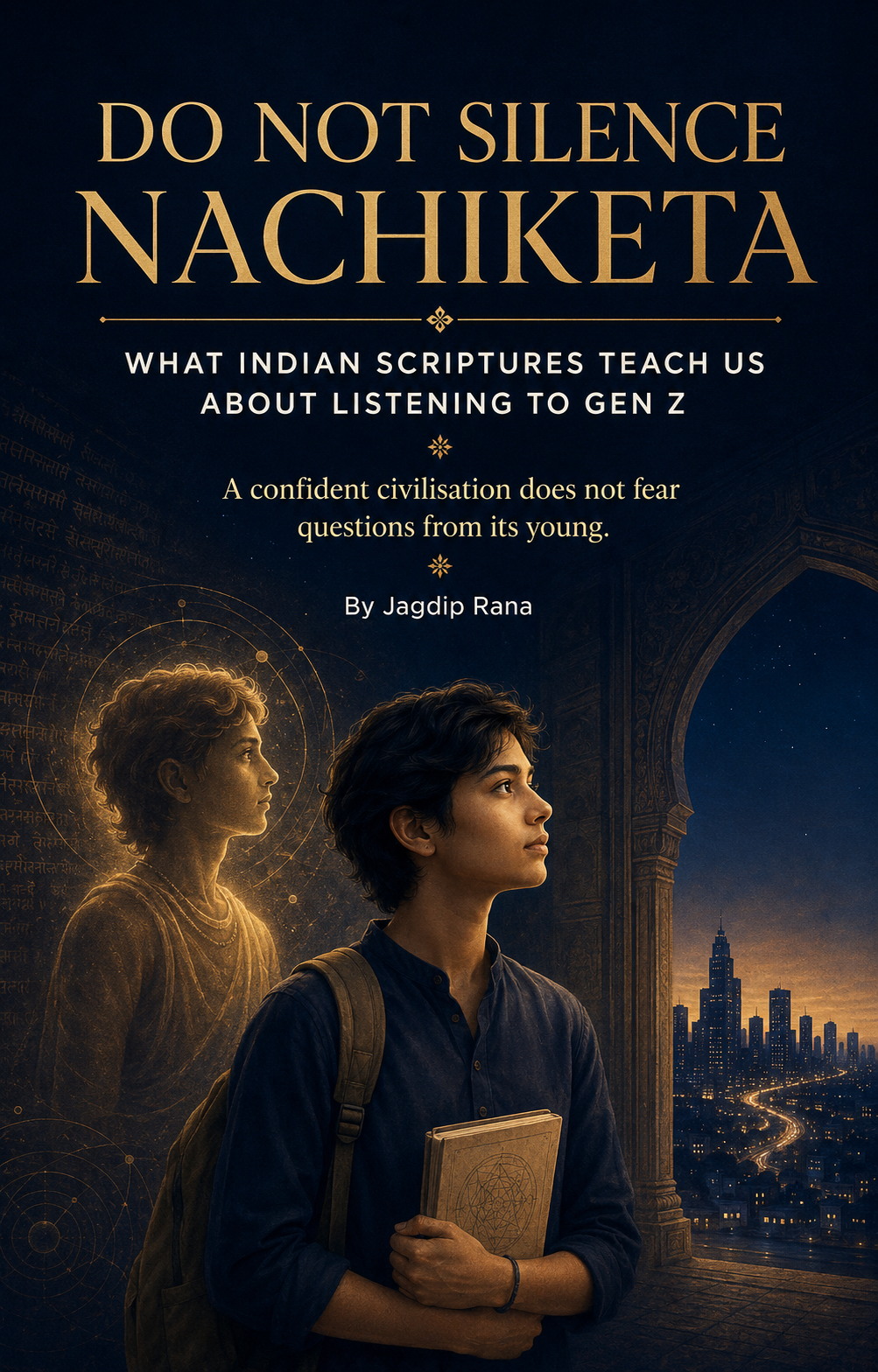
Perhaps the most compelling civilisational parallel is found in the Katha Upanishad. Nachiketa was a young boy who watched his father perform a religious sacrifice in which old and unproductive cows were being given away. Although the ritual appeared outwardly correct, Nachiketa recognised that its ethical purpose was being compromised. He asked his father an uncomfortable question: if everything was being offered away, to whom would he give his son? Irritated by the repeated questioning, his father declared that he would give Nachiketa to Yama, the lord of death.
Nachiketa subsequently confronted Yama with one of humanity’s most fundamental questions: what happens after death? Yama initially attempted to divert him by offering wealth, long life, comfort and pleasure. Nachiketa refused. He was not interested in distraction or appeasement; he wanted an honest answer to an essential question.
Indian tradition does not remember Nachiketa as an insolent child. It honours him as a courageous seeker of truth.
This contains an important lesson for our time: A young questioner may recognise an ethical contradiction that established authority has learned to overlook.
Gen Z’s impatience should not automatically be dismissed as immaturity. A student who has spent years preparing for an examination—often supported by the sacrifices of an entire family—has every right to demand that the examination system be fair, secure and transparent.
When merit is undermined by a paper leak or administrative failure, the loss is not merely academic. It damages confidence in the fundamental promise that honest effort will be fairly rewarded. The appropriate response to such questioning is not to silence Nachiketa. It is to answer him.
The Vedic principle of dialogue
The Rigveda offers a timeless principle for societies experiencing disagreement:
“संगच्छध्वं संवदध्वं सं वो मनांसि जानताम्। देवा भागं यथा पूर्वे संजानाना उपासते॥ “
“Come together, speak together, and let your minds be in harmony, just as the gods united in understanding, shared their offerings.” —Rigveda, 10.191.2
The verse does not demand uniformity of opinion. It calls for samvāda—the willingness to come together, speak and seek mutual understanding. In public life, dialogue cannot mean issuing a formal statement after decisions have already been taken. Nor can it consist merely of inviting a few selected representatives to communicate the government’s position. Genuine dialogue requires listening, disclosure of relevant facts, acknowledgement of demonstrable failures and a time-bound commitment to corrective action.
Young people must feel that they have been heard before their dissatisfaction reaches the streets. India must therefore move from episodic protest management to permanent youth engagement. Governments, examination authorities, universities and recruiting agencies should establish credible platforms through which students can raise concerns and receive accountable responses. Youth consultation should take place before a crisis erupts—not only after barricades have been erected.
The Gita begins with a crisis of confidence
The Bhagavad Gita itself begins with a warrior undergoing an intense crisis of confidence. Arjuna questions the duty he is being asked to perform. He is confused, emotionally overwhelmed and unwilling to act merely because authority or tradition expects him to do so.
Krishna does not ridicule his confusion. He does not order Arjuna to stop asking questions. He listens, reasons, explains and patiently addresses his doubts. Most significantly, after offering his guidance, Krishna tells Arjuna:
“इति ते ज्ञानमाख्यातं गुह्याद्गुह्यतरं मया। विमृश्यैतदशेषेण यथेच्छसि तथा कुरु॥“ “Thus, I have explained to you this wisdom, more profound than all that is profound. Reflect upon it fully, and then act as you choose.” —Bhagavad Gita, 18.63
This is an extraordinary model of leadership. Krishna provides knowledge and moral guidance, but he also respects Arjuna’s agency. He asks him to reflect and decide. Modern institutions can learn from this approach.
Gen Z cannot be addressed only through instructions, slogans or moral lectures. It is a generation accustomed to accessing information instantly, comparing competing claims and publicly questioning inconsistencies. It expects evidence, transparency and the freedom to arrive at its own conclusions. Authority may demand compliance, but only credible conduct can command trust.
The right—and discipline—of questioning
The Bhagavad Gita expressly recognises inquiry as a path to knowledge:
तद्विद्धि प्रणिपातेन परिप्रश्नेन सेवया। उपदेक्ष्यन्ति ते ज्ञानं ज्ञानिनस्तत्त्वदर्शिनः॥
“Seek that knowledge through humility, sincere questioning and service. Those who have realised the truth will impart knowledge to you.” —Bhagavad Gita, 4.34
The expression परिप्रश्नेन—paripraśnena is especially important. It recognises earnest and searching inquiry as a legitimate path to knowledge. At the same time, it associates questioning with sincerity, humility and a willingness to learn. This creates reciprocal responsibilities.
Institutions must answer genuine questions, release relevant information, investigate failures impartially and treat young citizens with dignity. They should avoid describing every critic as misled, politically motivated or anti-national. Young protesters also carry responsibilities. They must verify facts before circulating them, remain open to dialogue and ensure that legitimate anger does not turn into abuse, misinformation, destruction or personal vilification. Questioning authority is not disrespect. But questioning loses its moral force when it abandons truth and responsibility.
The moral discipline of protest
The Bhagavad Gita also identifies the qualities that should guide human conduct:
अहिंसा सत्यमक्रोधस्त्यागः शान्तिरपैशुनम्। दया भूतेष्वलोलुप्त्वं मार्दवं ह्रीरचापलम्॥
“Non-violence, truthfulness, freedom from uncontrolled anger, renunciation, tranquillity, avoidance of fault-finding, compassion towards all beings, freedom from greed, gentleness, modesty and steadiness.” —Bhagavad Gita, 16.2
This verse enables us to distinguish between justified indignation and uncontrolled anger.Anger at injustice can awaken public conscience. Uncontrolled anger, however, can damage the credibility of a movement and distract attention from the legitimacy of its demands.
Satire and memes have become part of Gen Z’s political vocabulary. Humour can puncture arrogance, expose contradictions and make complex issues accessible. But ridicule should not descend into dehumanisation. The right to dissent cannot become a licence for violence, deliberate falsehood or destruction of public property. Equally, the duty to maintain public order cannot become a justification for disproportionate force or the suppression of peaceful criticism.
The same moral standard must apply to the citizen and the state.
What the Ramayana teaches about consultation
The Ramayana reminds us that good governance requires consultation. Before proceeding with Rama’s proposed coronation, King Dasharatha convenes an assembly and places his proposal before representatives and citizens. Although he is the sovereign and believes Rama to be the right successor, he does not treat the decision solely as a royal prerogative. He seeks the opinion and approval of those he governs.
Rama, too, is portrayed as being deeply concerned with the welfare of citizens and conscious of their perceptions. Leadership in the Ramayana is not distant or insulated. It is responsive and rooted in an awareness of people’s lived realities.
The principle remains relevant: Even a well-intentioned government must consult those whose lives and futures will be affected by its decisions. Policies concerning education, competitive examinations, recruitment, skill development and employment should not be designed without meaningful youth participation. Consultation is not a concession that weakens authority. It is a process that strengthens the legitimacy and effectiveness of governance.
The anxiety goes beyond examination leaks
The immediate triggers for youth protests may be examination irregularities, but the underlying anxiety is much larger. India frequently speaks of its demographic dividend. But a demographic dividend cannot be created merely by celebrating the size and energy of the country’s young population. It requires dependable education, credible examinations, relevant skills, fair access to opportunity and dignified employment. When young people repeatedly encounter delayed recruitment, cancelled examinations, changing eligibility conditions, suspected paper leaks or a shortage of suitable opportunities, they do not experience these simply as administrative lapses. They see them as a breach of the promise made to them: study hard, compete fairly and build a better life.
Restoring this trust will require more than assurances. India needs:
- Stronger examination security and accountability
- Independent and time-bound investigations into paper leaks
- Clearly announced and reliably followed recruitment calendars
- Transparent communication whenever examinations are disrupted
- Fair relief for candidates affected by institutional failures
- Accessible and time-bound grievance-redressal mechanisms
- Meaningful youth representation in discussions on education, skills and employment
Most importantly, accountability must be visible. When institutional failures have identifiable consequences and corrective action is transparent, public confidence can begin to return.
A responsibility on both generations
This debate should not be reduced to a contest between “rebellious youth” and “unresponsive elders”. The older generation possesses experience, institutional memory and an understanding of the complexity of governance. The younger generation brings urgency, technological fluency, new perspectives and a refusal to accept inherited inefficiencies. India needs both.
Elders must resist the temptation to interpret every question as disrespect. Young people must resist the temptation to regard all experience as irrelevant. Authority without openness becomes rigid; dissent without discipline can become destructive.
The task is not to “control” Gen Z. It is to engage, guide and empower this generation while making institutions worthy of its trust.
Do not silence Nachiketa
The deepest lesson of Indian civilisation is not that the young must remain silent before authority. It is that sincere questioning can become a path to truth. Nachiketa questioned his father and later questioned Yama. Arjuna questioned Krishna. King Dasharatha consulted his people. The Rigveda called upon society to come together and speak together.
These examples do not glorify rebellion for its own sake. They establish a demanding ethical compact: those exercising authority must listen, explain and respond truthfully, while those challenging authority must do so with courage, discipline and responsibility.
India’s Gen Z is asking difficult questions about education, employment, fairness and its place in the nation’s future. Some of its methods and language may make the older generation uncomfortable. But discomfort cannot become a reason for dismissal.
A confident civilisation does not fear questions from its young.
It listens to them, reasons with them and transforms their impatience into constructive national energy.
India must not silence its Nachiketas. It must answer them.


Leave a comment